


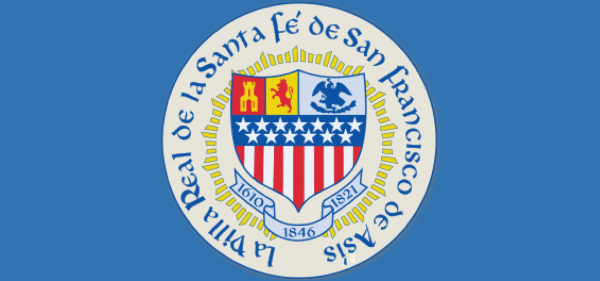
About Santa Fe, New Mexico
Santa Fe, known as the City Different, is one of the gems of the southwestern United States. Its downtown area is an architectural wonderland, with a southwestern theme dominating. To say that the city has Spanish and Puebloan influences would be an understatement. Culturally, the city is a haven for artists of all persuasions - galleries are to be found everywhere. In the world of music, the city is perhaps best known for the Santa Fe Opera, Santa Fe Symphony, ProMusica and the Santa Fe Chamber Music Festival.
Filmmaking is a big part of the Santa Fe economy. Here is a list of films shot in Santa Fe and another list of films shot in New Mexico. More information is available at the Santa Fe Film Office.
History and art buffs will marvel at the displays found at Loretto Chapel, New Mexico History Museum, Museum of Indian Arts + Culture, The Georgia O'Keefe Museum, New Mexico Museum of Art, IAIA Museum of Contemporary Native Arts and the New Mexico Capitol Art Collection.
Sports enthusiasts will appreciate Ski Santa Fe, River Rafting, Fishing, Hiking, Mountain Biking and Horseback Riding.
There are two cliff dwellings near Santa Fe that make for an interesting visit - Puye Cliff Dwellings and Bandelier National Monument. For the ambitious hiker, be sure to check out Kasha-Katuwe Tent Rocks National Monument - reservations required!.
Each year in Santa Fe, over 60,000 people attend the burning of Zozobra (also known as Old Man Gloom and sometimes branded as Will Shuster's Zozobra), an iconic arts event featuring a giant marionette effigy constructed of wood, wire and cotton cloth that is built and burned on the Friday of Labor Day weekend prior to the annual Fiestas de Santa Fe in Santa Fe. It stands 50 ft 6 in (15.39 m) high. The name is taken from the Spanish word zozobra referring to a strong feeling of anxiety or worries. By burning it, people destroy the worries and troubles of the previous year. The burning of Zozobra dates from 1924, when artist William Howard Shuster, Jr. created and then burned the first Zozobra in his backyard at a party for his friends and fellow artists.
One must not forget the shopping - this town offers some of the best Native American products available anywhere - and for all price levels. There is no shortage of boutiques and competing sidewalk vendors can be found everywhere, especially during fiesta times, such as the 314th Fiesta de Santa Fe and the Santa Fe Indian Market. Fiestas de Santa Fe has been held since 1712 to celebrate the Spanish reconquest of the city in 1692 by Don Diego de Vargas from the Pueblo tribes who had occupied the city since the Pueblo Revolt of 1680.
Santa Fe is the oldest capital city in the USA and the oldest European settlement west of the Mississippi River.
North of Santa Fe, you can visit the Eight Northern Pueblos, Nambe (Nanbe Owingeh), Ohkay Owingeh (formerly San Juan), Picuris, Pojoaque, San Ildefonso, Santa Clara, Taos, and Tesuque. The history of which dates back more than a thousand years.
West of Santa Fe, tourists can visit Los Alamos, one of the development places of the atomic bomb - the primary objective of the Manhattan Project by Los Alamos National Laboratory during World War II. J. Robert Oppenheimer, often called the "father of the atomic bomb", was the first director of the Laboratory. Durng World War II, the project's location was a tightly guarded secret, accessible from the outside world only through two security gates with documentation issued from an office in Santa Fe.
South of Santa Fe, visitors can enjoy the annual Albuquerque International Balloon Fiesta, which has grown to become the largest balloon event in the world. Held each year during the first week in October, the Balloon Fiesta now features about 600 balloons and 700 pilots. Last year, more than 800,000 guests visited Balloon Fiesta Park during the nine-day event.
Contrary to popular belief, Santa Fe is not technically high desert. It is a semiarid steppe at the crossroads of grass and shrub lands, a pinon-juniper woodland, and 1.6 million acres of high mountain coniferous national forest (with cold winters!). In addition to the 320+ days of sunshine, locals get to experience all four seasons. A semiarid steppe is a dry grassland region that receives between 10 to 20 inches of annual precipitation, which is enough to support short grasses but not forests. These areas typically have hot summers and cold winters, making them distinct from both deserts and more humid climates.
Santa Fe is recognized as one of the most intriguing urban environments in the nation, due largely to the city's preservation of historic buildings and a modern zoning code, passed in 1958, that mandates the city's distinctive Spanish-Pueblo style of architecture, based on the adobe (mud and straw) and wood construction of the past. Also preserved are the traditions of the city's rich cultural heritage which helps make Santa Fe one of the country's most diverse and fascinating places to visit.
The history of Santa Fe is a fascinating story.
Source: TOURISM Santa Fe and Wikipedia
About New Mexico
New Mexico is the fifth largest by area of the fifty states, but with just over 2.1 million residents, ranks 36th in population and 46th in population density. Its climate and geography are highly varied, ranging from forested mountains to sparse deserts; the northern and eastern regions exhibit a colder alpine climate, while the west and south are warmer and more arid. One-third of New Mexico's land is federally owned, and the state hosts many protected wilderness areas and national monuments, including three UNESCO World Heritage Sites, the most of any U.S. state.
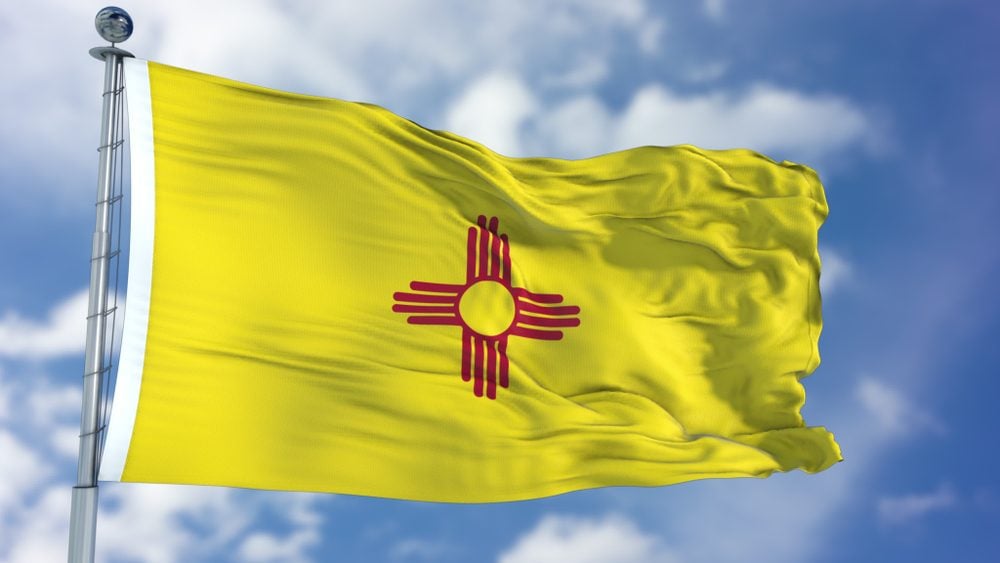
The New Mexico flag (image above) was adopted in 1925 and designed by Dr. Harry Mera, an archaeologist from Santa Fe. The colours are based on the flag of Spain, which had ruled New Mexico until the early 19th century as part of the Viceroyalty of New Spain. The flag features a red sun symbol, called the Zia, in the center. Both the sun and the number four are sacred to the Zia Pueblo people, an indigenous tribe originally from the Four Corners region. The Zia sun sign represents:
- the four cardinal directions (north, south, east and west),
- the four seasons of the year (spring, summer, autumn and winter),
- the four periods of each day (morning, noon, evening and night), and
- the four seasons of life (childhood, youth, middle years and old age).
These four elements are tied together by a circle of life that has no beginning and no end. It is also the belief of the Zia Indians that a human's life has four obligations which are sacred and must be fulfilled. Each person should strive to have a strong physical body, pure spirit, crystal clear mind, and the desire to help others. The New Mexico flag is one of four state flags that doesn't include the color blue. The other three are Alabama, California, and Maryland.
New Mexico's largest city is Albuquerque, population of 560,000, and its state capital is Santa Fe, the oldest state capital in the U.S., founded in 1610 as the government seat of Nuevo Mexico in New Spain. At the conclusion of the Mexican-American War in 1848, the U.S. annexed New Mexico as part of the larger New Mexico Territory. It played a central role in U.S. westward expansion and was admitted to the Union as the 47th state on January 6, 1912 by President William Howard Taft.
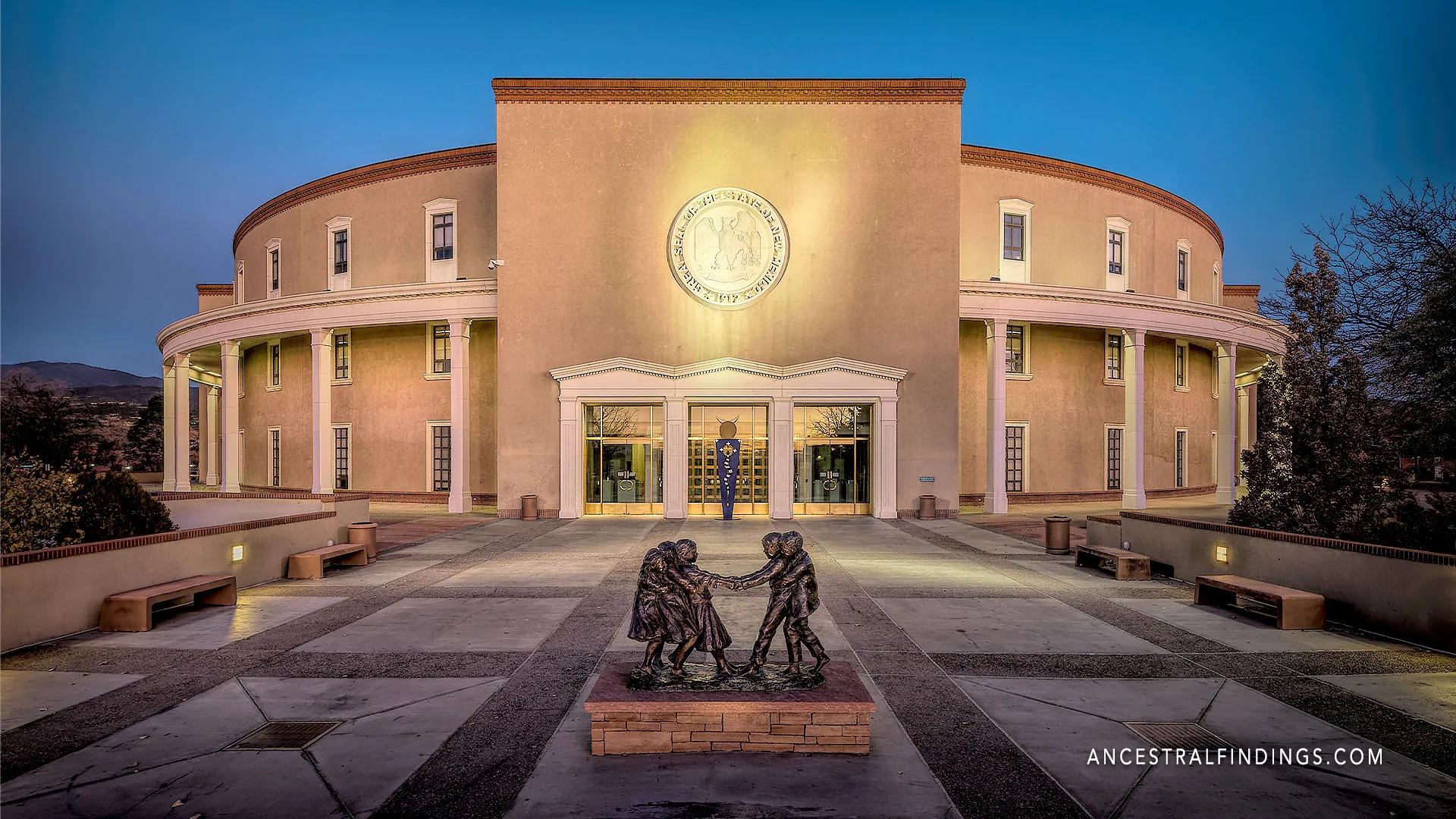
Today's New Mexico State Capitol in Santa Fe, known as the Roundhouse, is the only round capitol building in the country.
New Mexico has a population density of 17.5 persons per square mile. For reference, the state of Illinois has a population density of 231 persons per square mile. Only Montana, North Dakota, South Dakota, Wyoming and Alaska have a lower population density.
You can learn more about the State of New Mexico at this YouTube video.
Source: TOURISM Santa Fe and Wikipedia