


House Bills to Avoid Changing Clocks
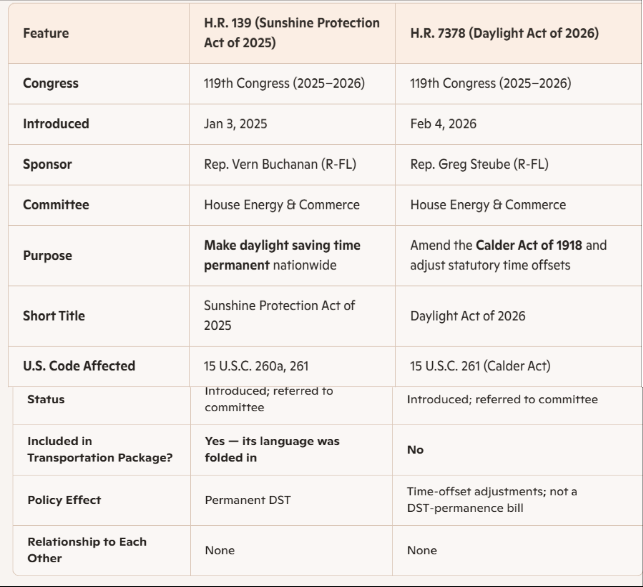
House Bill HR 139 - Sunshine Protection Act of 2025 - makes Daylight Savings Time (DST) permanent year around. This bill was introduced Jan. 3, 2025 as a provision in an amendment to the Motor Vehicle Modernization Act of 2026, which passed 48-1 in the House Committee on Energy and Commerce on Wednesday, May 21. On Tuesday, July 14, 2026, the measure passed the House on a 308-to-117 vote.
Under the provisions of this bill, Americans would observe Daylight Savings Time (DST) year-round. There may be some exceptions: According to section 3(b), states or parts of states that have already opted out of DST when the law takes effect may continue observing standard time year-round. Currently, only Hawaii and most of Arizona are affected by this clause. The bill does not allow states to opt out completely and continue changing their clocks independently of the federal system. The text does not state an effective date meaning the measure would become effective immediately upon being signed into law.
As of August 3, 2026, the Bill is awaiting approval by the Senate.
House Bill 9638 - Sunshine for Our Kids Act of 2026 - is a bipartisan bill that aims to establish permanent standard timeacross the United States By repealing Section 3 of the Uniform Time Act of 1966, thereby eliminating the need for daylight saving time changes. It allows states the option to adopt permanent daylight saving time if they choose. The bill was introduced on July 9, 2026, and has been referred to the House Committee on Energy and Commerce for further consideration.
While the federal default shifts to standard time, the bill includes a significant 'choose your own adventure' clause for state governments. Under the new Section 2(b), any state can pass its own law to opt back into daylight saving time on a permanent, year-round basis. The only catch is that the change must apply to the entire state (or, for states like Indiana or Tennessee that straddle two time zones, the entire portion of the state within a specific zone). This means we could see a map where one state stays on standard time while its neighbor chooses year-round DST. If you live in a border town, commuting from a standard-time suburb to a DST-observing city - your 20-minute drive could suddenly involve a one-hour time jump every single day.
By defaulting to permanent standard time, the sun will rise earlier in the winter, which is a win for parents waiting at bus stops with kids or construction crews starting early shifts in the cold. However, the trade-off is that the sun will set an hour earlier in the summer. If you’re a retail worker looking forward to a walk after your shift or a restaurant owner with a bustling outdoor patio, you might feel the sting of losing that extra hour of evening light.
The bill sets the implementation for the first Sunday of November following its enactment, giving businesses and state legislatures a fixed window to decide whether they want to stick with the new standard or pass a law to keep the late-evening sunshine.
House Bill 7378 - the Daylight Act of 2026 - is a bill that would permanently shift all U.S. time zones 30 minutes earlier than current standard time and eliminate Daylight Saving Time (DST) nationwide. It amends the 1918 Calder Act, the original federal law governing U.S. standard time, to redefine standard time and to implement 30 minute time zone differentials permanently. The Bill also repeals Section 3 of the Uniform Time Act of 1966 to eliminate DST, ending the twice yearly clock changes. As of now, the bill has been referred to the House Committee on Energy and Commerce and is pending further action.
Some Background
Source: The Hill - September 2026
Federal law only allows states to opt for permanent standard time, not permanent daylight savings time. Hawaii and much of Arizona have long exempted themselves from the biannual changing of the clocks - they observe standard time year-round.
Dozens of other states have tried to lock their clocks in recent years, including the nearly 20 that have enacted laws calling for permanent daylight saving time, which is not permitted under Federal law. However, legislation for permanent standard time remains under consideration in more than a dozen states.
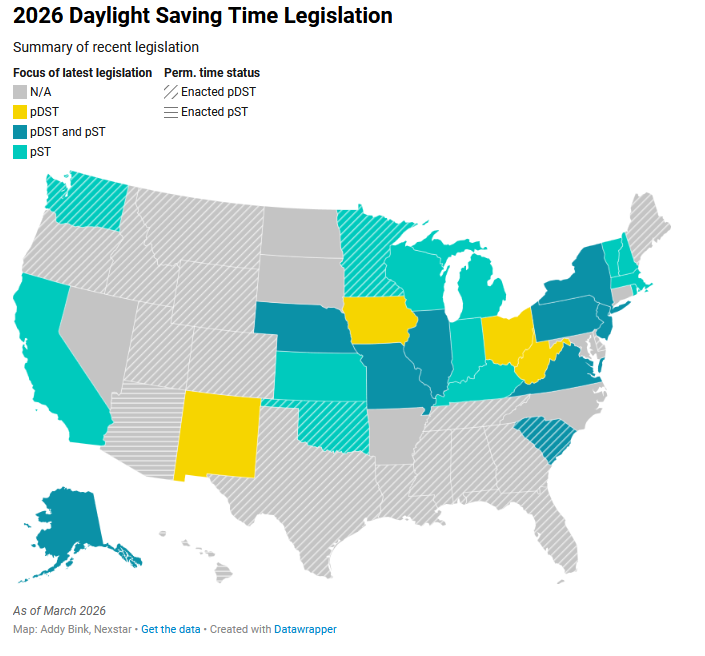
Health experts generally agree that we should lock our clocks on permanent standard time. There are five bills in Congress - two for permanent daylight saving time, two to leave the decision to the states, and one calling for half-daylight saving time - that remain in committees. It is too soon to say whether Congress will pass any of the bills that have been introduced, or whether any additional state-level laws will be enacted.
Surveys from the American Academy of Sleep Medicine (AASM) have found that about 63% of Americans would prefer to eliminate DST and NOT make it permanent. Researchers say that the change to DST has long-term negative consequences for our bodies and minds. Here are 7 things we've learned about how changing to DST negatively affects our lives.
The map below was prepared by WGN-TV in Chicago showing that if DST were made permanent, sunrise in parts of some northern states would not occur until after 10:00am. Many counties would see sunrise at around 9:30am.

The Emergency Daylight Saving Time Energy Conservation Act enacted year-round daylight saving time for a two-year experiment from January 6, 1974, to April 7, 1975, but Congress later ended the experiment early on October 27, 1974, and did not make it permanent due to unfavorable public opinion, especially regarding concerns about children walking to school and waiting for school buses on dark winter mornings. Sunrise for most of the country came around 8:30 a.m. or later in the dreariest parts of winter, so most people commuted to work and school in the dark. Americans said the sunless mornings made them cranky, sad and less safe.
Unless the Senate adopts the House bill, our clocks will fall back an hour on Sunday, November 1, 2026 at 2:00am - the first Sunday in November.
See also Menu > Time > Time Designations for a discussion of time zones.